


Blog
The 2026 HVAC Refrigerant Phase-Out: What Southwest Florida Homeowners Need to Know
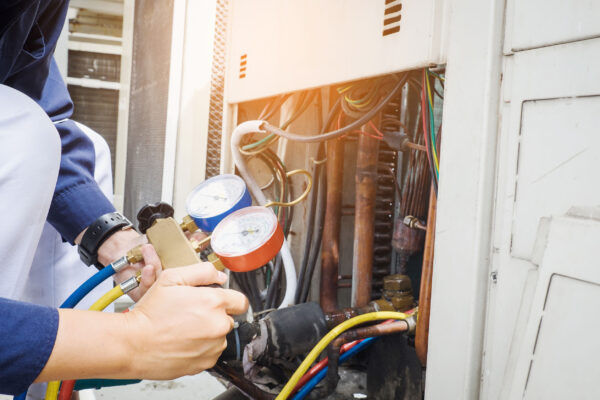
New federal regulations are reshaping the cooling industry, but they do not require homeowners to replace perfectly functional equipment. The 2026 HVAC refrigerant transition is a regulatory shift mandated by the EPA's AIM Act to phase down high-GWP hydrofluorocarbons like R-410A in favor of environmentally friendly alternatives like R-454B and R-32. While the manufacturing of new R-410A residential systems has ceased, existing units remain legal to own, maintain, and repair.
Gulf Shore Cooling provides clear documentation and transparent evaluations across Fort Myers, Bradenton, and Sarasota to help homeowners navigate the changing industry standards.
Are Older Air Conditioners Becoming Illegal?
No.
One of the biggest misconceptions surrounding the 2026 refrigerant transition is that homeowners will be forced to replace existing equipment. The EPA rule targets the production and import of new cooling equipment, not current homeownership.
If your current system uses R-410A, it remains legal to operate, maintain, and repair. Contractors can continue servicing grandfathered systems, and pre-existing inventory manufactured before the production cutoff can still be installed while supplies remain available.
What is the EPA's AIM Act and Why is Refrigerant Changing?
The American Innovation and Manufacturing (AIM) Act was created to reduce hydrofluorocarbons (HFCs) by 85% by 2036.
The driving factor behind the change is Global Warming Potential (GWP), which measures how much heat a refrigerant can trap in the atmosphere. R-410A has a GWP of 2,088, while next-generation refrigerants operate at significantly lower levels.
As part of the new AC rules, newly manufactured residential equipment must use refrigerants with a GWP below 700.
Understanding Next-Generation Cooling Technology
The two most common replacement refrigerants are R-454B and R-32.
- R-454B (Known commercially as Puron Advance™ or Opteon™ XL41): a blend of R-32 and R-1234yf that operates at pressures similar to R-410A. With a GWP of 466, it has become a popular choice among major residential equipment manufacturers.
- R-32: a single-component refrigerant with a GWP of 675. Because it is not a blended refrigerant, it can be simpler to recover and recharge in certain situations.
Both fall into the ASHRAE A2L safety class, meaning they are classified as 'mildly flammable.' To be clear: an A2L refrigerant cannot spontaneously ignite. It requires a direct, concentrated open flame and a massive, rapid leak in a completely sealed box to catch.
To eliminate even this microscopic risk, 2026 systems feature an active mitigation loop: if an internal sensor detects a refrigerant drop, the system instantly shuts off the outdoor compressor and locks the indoor fan on 100% to safely disperse the gas.
Can Next-Gen Coolants Be Used in Existing Units?
No.
R-454B systems and R-32 equipment are not backward compatible with older R-410A units. The lubricants, operating characteristics, safety controls, and equipment design are different. Mixing refrigerants or attempting to retrofit incompatible equipment can damage the system and void manufacturer warranties.
This is one reason homeowners asking, "Are R410A air conditioners being banned?" often misunderstand the transition. Existing systems remain serviceable, but future replacement equipment will use different refrigerants.
Furthermore, the 2026 rules eliminate 'partial swaps.' If your outdoor compressor fails this year, an HVAC contractor cannot legally install a new A2L outdoor unit and connect it to your existing R-410A indoor air handler. Because A2L systems require dedicated, spark-free internal blowers and specialized communication boards, a 2026 equipment replacement must be a complete, matched indoor/outdoor system upgrade.
Why Are Current AC Repair and Recharge Costs Rising?
As production quotas for R-410A continue to decrease, supply becomes more limited. Basic supply-and-demand economics affect refrigerant pricing throughout the industry.
For homeowners facing major repairs, understanding the long-term viability of the current system becomes increasingly important.
During professional ac repairs, Gulf Shore Cooling documents equipment age, repair history, leak history, and overall operating condition. This data helps homeowners compare repair costs against replacement costs using objective information rather than guesswork.
Regular AC maintenance can also help identify refrigerant issues early, reducing the risk of larger repair bills later.
Plan Ahead with a Clear Assessment of Your Home's Cooling
The best approach to the 2026 refrigerant transition is proactive planning rather than reacting to an emergency breakdown.
A system evaluation provides detailed insights into your equipment’s age, performance, refrigerant type, and overall condition. That documentation allows homeowners to make decisions on their own timeline instead of making a rushed decision during a cooling emergency.
If questions arise about equipment condition, refrigerant type, or future replacement planning, Gulf Shore's air conditioning services team can provide additional guidance.
Contact our team for your system evaluation.
Frequently Asked Questions
Yes, 100%. If you bought an R-410A system in 2023 with a 10-year registered compressor warranty, the manufacturer (Carrier, Lennox, Rheem, etc.) is legally bound to honor that warranty through 2033. They are required by law to maintain a dedicated stockpile of R-410A replacement coils specifically to service warranty claims.
Under the EPA’s mandated step-down schedule, reclaimed and recycled R-410A will remain fully legal and available for servicing existing systems until at least 2036. While the price per pound will rise as virgin stockpiles shrink, you will not be cut off from recharging a healthy system anytime soon.
Yes, roughly 10% to 15% more than equivalent 2024 models. This price increase is not a "contractor markup", it is the hard manufacturing cost of the newly mandated, factory-installed dissipation sensors, thicker copper coil walls, and spark-proof electronic contactors.
Walk outside to your large metal condenser and look at the manufacturer's data plate (the silver or white sticker with the bar codes). Look for the line labeled "Factory Charge" or "Refrig." If it says R-410A or Puron, you are on the legacy system; if it says R-454B, Puron Advance, or R-32, you are already ahead of the curve.
Yes. A2L refrigerants cannot be ignited by household static or standard electronics. Furthermore, modern units come with built-in leak sensors that instantly shut off the outdoor compressor and turn on the indoor fan to safely disperse the air if a pressure drop occurs.
No. You will keep the exact same schedule: twice a year (Spring and Fall). Florida’s harsh climate still requires standard coil washing and drain line clearing. The only difference happens on our end: during your routine tune-ups, our technicians now use specialized digital tools to test the unit's onboard A2L safety sensors.